🐼 pandatonev0.4.0
archived
2026.08.28 updated 2026.09.16
palette management for robots
readme
palette management for robots
Archived. Pandatone was an attempt to create a small, sharp tool used that could be easily integrated to help manage consistent color usage across projects. It got heavy, fast. I learned a lot, but ultimately decided this was not the way to solve this particular set of problems.
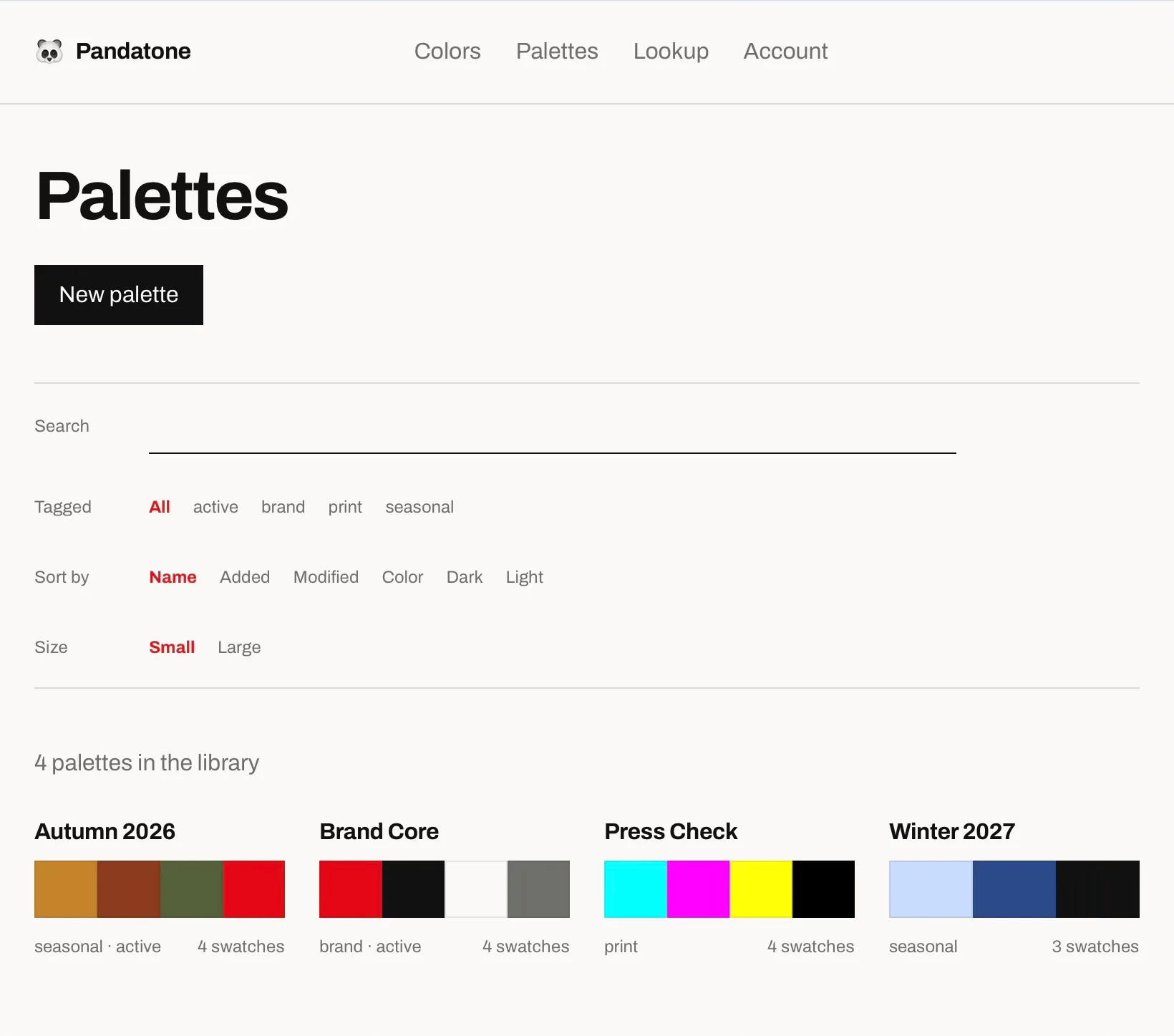
A palette library as a Rails engine: named, tagged colors and the palettes
that hold them, with a versioned JSON API and a Ruby interface, so other tools
can ask two questions — give me the colors of the palette tagged active, and
which palettes contain #E30613.
quickstart
# Gemfile — not on RubyGems; taken from its main branch
gem "pandatone", github: "bobbymeyer/pandatone", branch: "main"

# config/routes.rb
mount Pandatone::Engine, at: "/pandatone"
bin/rails db:migrate # the engine's migrations run with the host's
bin/rails pandatone:seed # a small real library; idempotentTables are prefixed pandatone_. Written for SQLite — tags are queried with
json_each.
what the host provides
| The door | Screens inherit the host's ApplicationController, API endpoints the host's ApiController. The engine never learns what a user is |
| The shell | The host's layout renders its_swiss/shell and places yield :sections, where Colors, Palettes and Lookup arrive |
| The theme | Accent, typeface, value scale, field count and baseline are the host's, set in its theme.css |
| The script | its-swiss registers its own Stimulus controllers; the engine registers its own. The host adds nothing to its importmap |
# config/initializers/pandatone.rb — set before the engine loads
Pandatone.base_controller_class = "ApplicationController"   # default
Pandatone.api_base_controller_class = "ApiController"       # default
A host with no door sets these to ActionController::Base and
ActionController::API.
Inside an engine request the bare route helpers are the engine's, so a host
layout calls its own through main_app.
Ruby interface
Plain arguments in, plain data out — the same hashes the API serializes, never a record of the engine's. The API's read endpoints call these same methods.
| Call | Returns |
|---|---|
Pandatone.palette(key) |
One palette with its colors in order, by id or name |
Pandatone.palettes(tag:, containing:, q:, sort:) |
Palette summaries |
Pandatone.palette_colors(key, sort: nil) |
The colors of one palette, in the palette's order unless sorted |
Pandatone.colors(tag:, value:, in_palette:, q:, sort:) |
Colors |
Pandatone.lookup(query) |
{ query:, hex:, rgb:, build:, colors:, palettes:, nearest: } |
Pandatone.tags |
{ colors: [...], palettes: [...] } |
Pandatone.palettes(tag: "active")
Pandatone.palettes(containing: "#E30613")
Pandatone.palette_colors("Brand Core")
Pandatone.lookup("227, 6, 19")
containing takes a hex, an RGB triple or a CMYK build. Sorts are name,
added, modified, spectrum, dark, light.
Anything else — Pandatone::Palette.where(...) — is reaching into the engine.
HTTP API
Everything under /api/v1. JSON by default. Collections are bare arrays, no
envelope. A token in the header, never the session cookie.
| Route | Methods |
|---|---|
/api/v1/openapi |
GET — describes the API; not behind the token |
/api/v1/palettes |
GET, POST |
/api/v1/palettes/:id |
GET, PATCH, DELETE |
/api/v1/palettes/:id/colors |
GET |
/api/v1/colors |
GET, POST |
/api/v1/colors/:id |
GET, PATCH, DELETE |
/api/v1/lookup |
GET |
/api/v1/tags |
GET |
curl -H "Authorization: Bearer $PANDATONE_TOKEN" \
     https://example.com/pandatone/api/v1/palettes?tag=active
A color comes back as:
{
  "id": 12,
  "name": "signal-red",
  "hex": "#E30613",
  "rgb": { "r": 227, "g": 6, "b": 19 },
  "cmyk": { "c": 0.0, "m": 97.4, "y": 91.6, "k": 11.0 },
  "source_space": "rgb",
  "tags": ["brand", "primary"]
}
That shape, key order included, is pinned by a contract test. The way to change v1 is to add v2.
exports
Extensions on the palette routes.
| Extension | Gives |
|---|---|
.ase |
Adobe swatch exchange; each color in the space it was authored in |
.css |
Custom properties on :root, in the palette's order |
There is no export of the whole library — a palette is the unit with a name and an order.
the domain
Colors are first-class, not children of palettes. One brand blue used in ten palettes is one row joined to ten palettes, which is what makes the reverse lookup possible.
| Rule | Enforced |
|---|---|
| A color is its value — no two colors may render the same hex | At the write |
| No two palettes may hold exactly the same set of colors; order is not part of the identity | At the write |
Near-duplicates inside a redmean distance of 32 (0–765 scale) |
Warned, with a "create anyway" button |
Every color stores both RGB and CMYK. source_space records which was
authored; the other is redrawn on every write, so the two cannot drift. RGB
round-trips through CMYK losslessly, but many CMYK mixes collapse onto one RGB
triple.
dresser
Pandatone::Dresser is how another tool composes in value — a pattern of
ranked slots — and asks what those values are wearing.
| Piece | Is |
|---|---|
Dresser::Catalog |
Every palette, fetched once from Dresser.source and filtered locally |
Dresser::Palette, Dresser::Color |
The wire format read back |
Dresser::Luminance |
OKLab L, so a palette ranks lightest first — slot 0 is the ground |
Dresser::Colorway, Dresser::Snapshot, Dresser::Rule |
Concerns for the consumer's own records |
Dresser::Drift |
Whether the palette has moved since, as a sentence. Reported, never applied |
Dresser::Dressing |
The controller's three lines: catalogue, palette, drift report |
Views and helpers: pandatone/dresser/picker, pandatone/dresser/actions,
palette_strip, slot_swatch, rule_in_words, and pandatone/dresser.css.
| Variable | Sets |
|---|---|
PANDATONE_URL |
Unset: the Pandatone in this process, through its public methods. Set: that Pandatone over HTTP |
PANDATONE_TOKEN |
The bearer token for the HTTP source |
class Stripeclub::Colorway < ApplicationRecord
  include Pandatone::Dresser::Colorway
  belongs_to :pattern
  has_many :rules, class_name: "ValueRule", dependent: :destroy
  delegate :slot_count, to: :pattern
end
not here
No color science. No ICC profiles, no Lab, no spot colors, no gamut mapping. CMYK is stored and served, labeled an approximate device conversion.
tech
Rails engine, v0.4.0. Ruby >= 3.2, Rails >= 8.0 and < 9. Propshaft, importmap, Turbo, Stimulus and its-swiss >= 1.0 come with the gem. SQLite. Minitest.
bin/rails test # 375 runs, 5199 assertionsSystem tests run through rack_test by default, so the suite needs no browser
and the app keeps working with JavaScript off.
license
MIT.